
SJMA
DOCENT
COUNCIL
Legacy: The Emily Fisher Landau Collection
June 4, 2014
-
September 14, 2014


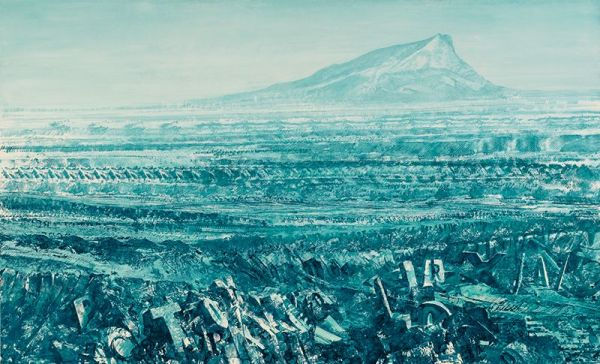


“Art is the greatest teacher,” is one of Emily Fisher Landau’s favorite expressions, and the driving force behind her art collection. Landau is an adventurous and open-minded patron who purchased work by pioneering artists long before they became famous. Her collection chronicles many of the ideas and social forces that defined the American art scene between 1960 and 2002, a vital time when artists opened closets, doors, and windows and blew out preconceived ideas of what art is, or should be, in favor of what art can be.
Legacy: The Emily Fisher Landau Collection is an art-historical survey of an era of near-constant change. It spans the Cold War, the Civil Rights Movement, the war in Vietnam, the advent of mass-media culture, the rise of feminism and multiculturalism, and the gay liberation movement. This exhibition offers us an opportunity to put the explorations of American artists into both aesthetic and cultural context.
No single style or “ism” held sway: it was a period with many crosscurrents and no one mainstream. Artists mined the subconscious; critiqued consumer culture’s assembly-line ideals, images, and products; recontextualized the cool anonymity of Minimalism; probed the relevance of painting; reflected the state of ennui they found in middle-class America; relit debates about representation and the figure; and pursued personal narratives. Above all, they questioned the status quo.
Art can teach us about the world. It can offer alternative ways of thinking, and it can teach us about ourselves. Many of the artworks in Legacy heralded seismic changes, not just in American society, but in the way the artist’s role was evolving. This exhibition offers insights into the visual thinking and political consciousness of American artists over a forty-three year stretch, with a particularly close look at the 1970s and 1980s.
Landau became one of the preeminent collectors of postwar art in the United States.
This exhibition is drawn from her historic promised gift to the Whitney Museum of American Art, New York, of which she was a longtime trustee. As did the earlier “Whitney collaborations” at the San Jose Museum of Art—the beloved, landmark surveys of twentieth-century art from the Whitney’s collection presented at SJMA from 1994 to 2000—Legacy gives audiences access to extraordinary works by a pantheon of innovative and pivotal artists. It proudly launches SJMA’s forty-fifth-anniversary celebration, with a tribute to the past.
Some seventy works by thirty-eight artists range from painterly abstraction to high realism to social commentary. Legacy includes an equally broad variety of media, e.g. ink on paper, collage, screen printing, painting, and sculpture. It encompasses a punchlist of postwar art movements: abstract expressionism, pop art, minimalism, conceptualism, feminist art, and postmodernism. Also on view are works by Carl Andre, John Baldessari, Matthew Barney, Peter Cain, Carroll Dunham, William Eggleston, Eric Fischl, Felix Gonzalez-Torres, Rodney Graham, Keith Haring, Peter Hujar, Neil Jenney, Joseph Kosuth, Annette Lemieux, Sherrie Levine, Glenn Ligon, Robert Longo, Robert Mapplethorpe, Agnes Martin, John McLaughlin, Martin Puryear, James Rosenquist, Susan Rothenberg, Allen Ruppersberg, Lorna Simpson, Kiki Smith, Mark Tansey, Al Taylor, Cy Twombly, and David Wojnarowicz.
Docent Conversations
Share Your Thoughts and Information
Did you learn something interesting about the exhibition while doing research, talking with a visitor or museum staff, attending an artist talk? This area is a place for docents to have an ongoing conversation about an exhibition, artists, and artworks. The more we share the more we learn.